
How to Stop Roof Rack Wind Noise
Roof rack wind noise doesn’t come from the wind — it comes from aeroacoustic resonances inside the T-slots. Here’s the simple and cheap fix that eliminated the loud whistling on my Slimline II rack.

Most roof-rack wind noise comes from a surprising source — not the wind itself, but tiny aeroacoustic resonances inside the T-slots. Here’s why your rack whistles, how the physics works, and the simple fix that completely eliminated the noise on my Front Runner Slimline II.
Sound
Sound consists of vibrations that propagate through gases, liquids, and solids, and travel at different speeds depending on the medium.
In air—where the molecules are relatively far apart—sound waves travel as pressure and density fluctuations at around 340 m/s. The propagation occurs in the form of longitudinal waves, which oscillate in the direction of travel.
In solids, in addition to longitudinal waves, transverse waves can also propagate, where the oscillation is perpendicular to the direction of travel. This is only possible in a rigid atomic lattice. As a result, the speed of sound in steel is much higher, typically between 5000 and 6000 m/s.
Wind Noise and Boundary Layers
The wind noise we hear while driving is caused by turbulence along the outer surface of the vehicle. The faster you drive, the stronger the pressure fluctuations become—and the louder the noise.
As air flows over a smooth surface, such as a car body, it forms a boundary layer that grows thicker the farther it travels. Within this boundary layer, the flow can be laminar or turbulent.
Boundary layers are technically extremely important. A comprehensive reference work on the subject was compiled by Hermann Schlichting and Klaus Gersten in Boundary-Layer Theory, which is considered a standard in fluid mechanics and numerical fluid dynamics.
Boundary layers are critical in aircraft because they determine how long a clean, attached flow remains over a wing. If the angle of attack becomes too high, the boundary layer can no longer follow the airfoil contour and separates.
When this happens, the airflow detaches over a large portion of the upper wing surface, lift drops sharply, and drag increases dramatically—this is known as an aerodynamic stall.
During landing, a stall is deliberately avoided: the flaps increase wing camber and generate more lift at lower speeds, reducing the stall speed. If a local or incipient stall does occur, the aircraft may briefly lose lift, which can feel like a short “dip.”
Turbulence is everywhere — but whistling is optional.
Turbulence cannot be avoided. But whistle-producing resonances can.
Wind deflectors on the rack don’t eliminate these noises either. They only redirect the airflow and help guide it over the rack. But wherever the flow separates, strong turbulence will still form. That cannot be avoided.
With the rack’s T-slots it’s a different story. Here we have narrow cavities that run across the entire width of the rack, both on the top and bottom. These cavities are oriented perpendicular to the flow direction. In the illustration below, I’ve shown a cross-section of the rack and the airflow streamlines in white as they move across it.

Flow Separation at the Groove Edge
When the external airflow passes over the sharp edge of the groove, the boundary layer can no longer follow the contour and separates. This creates an unstable shear layer above the groove, while inside the groove the flow velocity is very low, resulting in low static pressure. Outside the groove, however, the high flow speed produces high dynamic pressure.
Periodic Behavior
The separated shear layer begins to oscillate between the high dynamic pressure outside and the low pressure inside the cavity. This leads to periodic flow separation, which acts like a kind of “pumping effect” into and out of the groove. This periodic behavior is characteristic of cavity resonances and can generate a clear, whistling tone.
The Aluminum Profile as a Resonator
The aluminum rack profiles, with their long groove, also act as an acoustic resonator. Depending on their length, depth, and opening geometry, they can behave like a Helmholtz resonator or like an elongated cavity. This amplifies the oscillations triggered by the separated shear layer – producing the characteristic whistling noise.
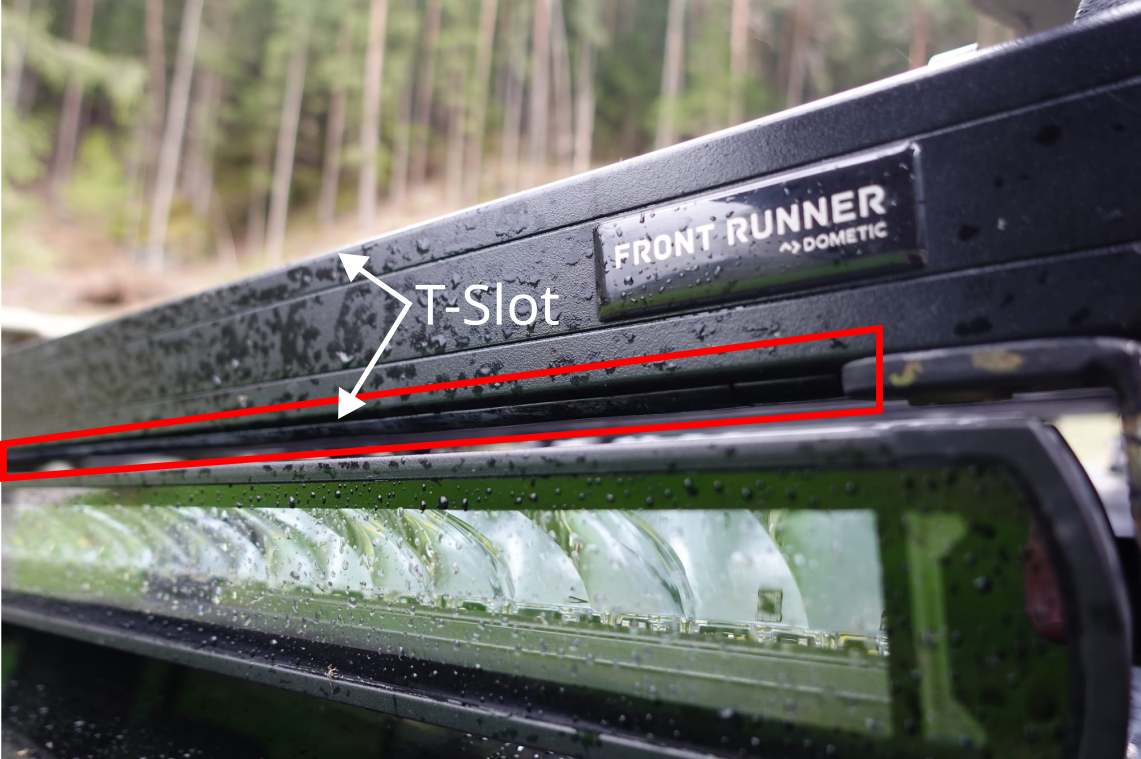
We experienced significant wind noise and an annoying whistling sound while driving with our Front Runner Slimline II roof rack. These issues became even more pronounced after we installed a front-facing LED light bar. The wind was funneled through the narrow gap between the LED bar and the front rail of the rack, which caused it to accelerate and produce a high-pitched whistling noise at various speeds.
A key factor contributing to this problem is the 9 mm T-slot channel located on both the top and bottom of each rail. These open slots can easily create turbulence when air passes through or over them. However, the primary cause of the loud whistling was the tight space between the LED bar and the front rail, which acted like a wind tunnel, amplifying the noise significantly.
The airflow over the open grooves still exists even with a wind deflector — it’s just less intense.
On racks like mine, where a full-width LED light bar is mounted at the front, I can’t use a wind deflector at all. The critical area is where the airflow accelerates strongly: between the light bar and the underside of the rack. There’s also a groove in that exact spot, and that’s what produced the main whistling sound. 😄
Why the T-slot Gasket Works
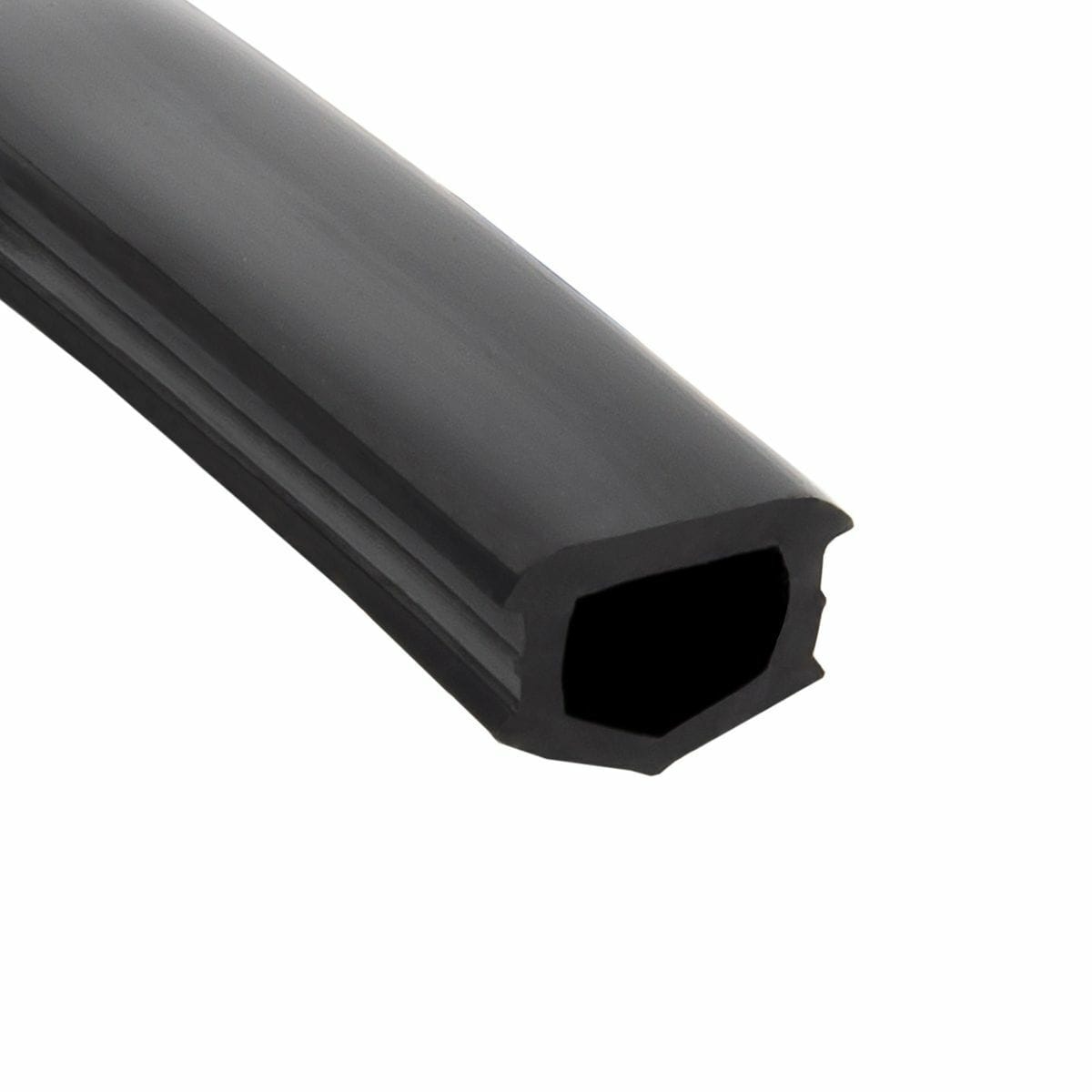
By filling the open groove with a rubber T-slot strip, the geometry of the cavity changes completely. The shear layer can no longer form a stable oscillation over the opening, the internal volume is sealed, and the pressure fluctuations that drive the resonance disappear. The airflow still passes over the rack, but the acoustic feedback loop is broken — and the whistling noise is gone instantly.
The only effective and affordable solution is to seal the T-slots with a simple rubber insert like this one from eBay. It’s much cheaper than the original Front Runner version. I needed about 30 meters for my rack because the slots are present on both sides (top and bottom).
Want to know more about technical solutions for overlanding and for a self-sufficient life, that have been field tested and developed for reliability and durability?